Tuesday, February 2, 2016

Device Plate - and a lot more

Battery Box - Black Box

After mounting the battery box it was time to fill it up. As mentioned in the latest post, it was filled with two levels of batteries. Yeah, I know, it's going to be hell to maintain the batteries and check for problems. But heck, that's a consistent design flaw in my conversion. Also the batteries on the bottom of the car are only reachable if I remove them starting from the rear end. Talking of these batteries on the bottom: to give them extra protection against moisture and salt water, I intend to spray the terminals with PlastiDip. This should help to prevent corrosion and is easily removable should the need arise.
Aside from loading the battery box, I also mounted an external box (grey) to hold another HV fuse. Not knowing what exactly happens when such a fuse blows, I think it's a good idea to keep them well separated from the batteries - outside of the box (still some lingering impressions from the short circuit).
The black wire you see attached with hot glue in the battery box is the wire from a temperature sensor. The sensor was glued inbetween 4 cells. It's used to ensure that the batteries are not charged below freezing point and to detect a run-away situation during use or charge. I know it's crude - but I don't like too many wires dangling around the cells and calling for other trouble.
The top level of cells had to be added row by row and pushed under the already welded on cover. The cover had to be welded on because it will go under the front cover and can't be removed anyway. The grey block you see on some pictures is a sanding block for PCB's - to get polished copper which easily accepts soldering tin. I got it from www.conrad.ch. In my opinion it's perfect to create a clean and shiny surface on the battery poles and straps. It creates some dust which can be easily removed with a handheld vacuum cleaner - no issue.
The battery box in the back is currently made out of wood aas a prototype. Here we need to bend some metal so the batteries will fit in to the spare tire compartment and use up no space at all in the trunk. I'm pretty proud that until now the only change to the structure of the car was made in the spare tire compartment. There I had to drill the only holes. Otherwise no change on the car structure was made - no hole drilled, nothing. I mounted all parts on the vanilla structure, used only existing mounting points and through holes. Cool, eh ? :)

Device Plate - Aluminum Sandwich

First I created a prototype out of an MDF plate. It was very useful because I drilled a lot of unnecessary holes and was able to experiment with the setup. It also helped getting all the details worked out at the rear of the plate, where the car - once again - shows no straight lines. Based on this template, www.fahrzeugsausbau.ch created a final plate out of an aluminum / PE sandwich plate very easily. It's very robust (unbreakable ?) and lighter than a pure aluminum plate - a good choice. The plate resides on 3 angles attached to the firewall (created out of an L-profile) and on the front on a lid which was welded earlier to the battery box. Even fully loaded with all the devices and thanks to routing the wires and cables at the back of the plate, I'm now able to lift the plate about 20cm at the front and get access to all the stuff below it. On the underside there was also enough space to mount the 6kW heater from a wrecked Chevy Volt.

EHPS pump - Powerful but noisy

With the help of www.klaus-ag.ch we also got the electro hydraulic power steering pump hooked up to the original hydraulic system. It required three high pressure connections. With some makeshift (oh no, not again !) electric connections to a 12V battery, I got it running, lowered the car to the ground and kept steering happily from left to right for about 10 minutes - like a child. Don't worry, the tires are to be replaced anyway - but I left two black marks on the floor - whoops :)
A quick visit to a junkyard revealed the necessary connectors for the pump so a professional installation can be made. It's interesting, the pump has an 80 Amps fuse but only 10sqmm cables (7 AWG) where all tables state for 80 Amps you'd require 16sqmm cables. Well, normal load on the pump is way below 40 Amps and I hope the guys at Volvo know that a short on a 10sqmm cable is able to blow a 80Amps fuse before melting down.
Although I bought a new one, it's well worth looking for an electric power steering pump on the junkyard. Volvo V50's and V40's after 2008 tend to have one. Make sure you get them with mounting brackets and plugs. Two things I have to say about the pump: 1) It's a bit noisy.. I hope with some rubber foam, I'll be able to make it more quiet. Otherwise the "silent e-car" will not become reality. 2) The folks at TWR suck ! It took me about 10 calls to reach the technical responsible only to be told off quiet harshly that they don't provide support for car shops. Only car manufacturers. They won't even give out a CAN matrix - for their product which I bought through official channels. Shame on you TWR !

Fuse Box - Finalization of 12V connections


To finally clean up this mess of cables you see on the left side of the car (right on the picture), I also straightend the 12V system out. Cables were shortened and connected properly to the car's 12V supply line with 50sqmm butt connectors. To hook up the auxiliary 12V battery (remember ? a tiny 9Ah motor cycle lead acid battery), I spotted an empty space in the high-amp fuse area of the engine bay fuse box (red arrow). It's always on 12V - unswitched. I installed a 50amps fuse there. Also to get the constant 12V for the contactors and other EV stuff, I located an unused place for mini fuses which has 12V without ignition on. that's what I need to be able to activate the contactors when charging.
There's another free place for a similar fuse which I'm going to use for the EHPS pump. I'll try a 70 Amps at first to be on the safe side.

Cooling Loop - Angles and Air

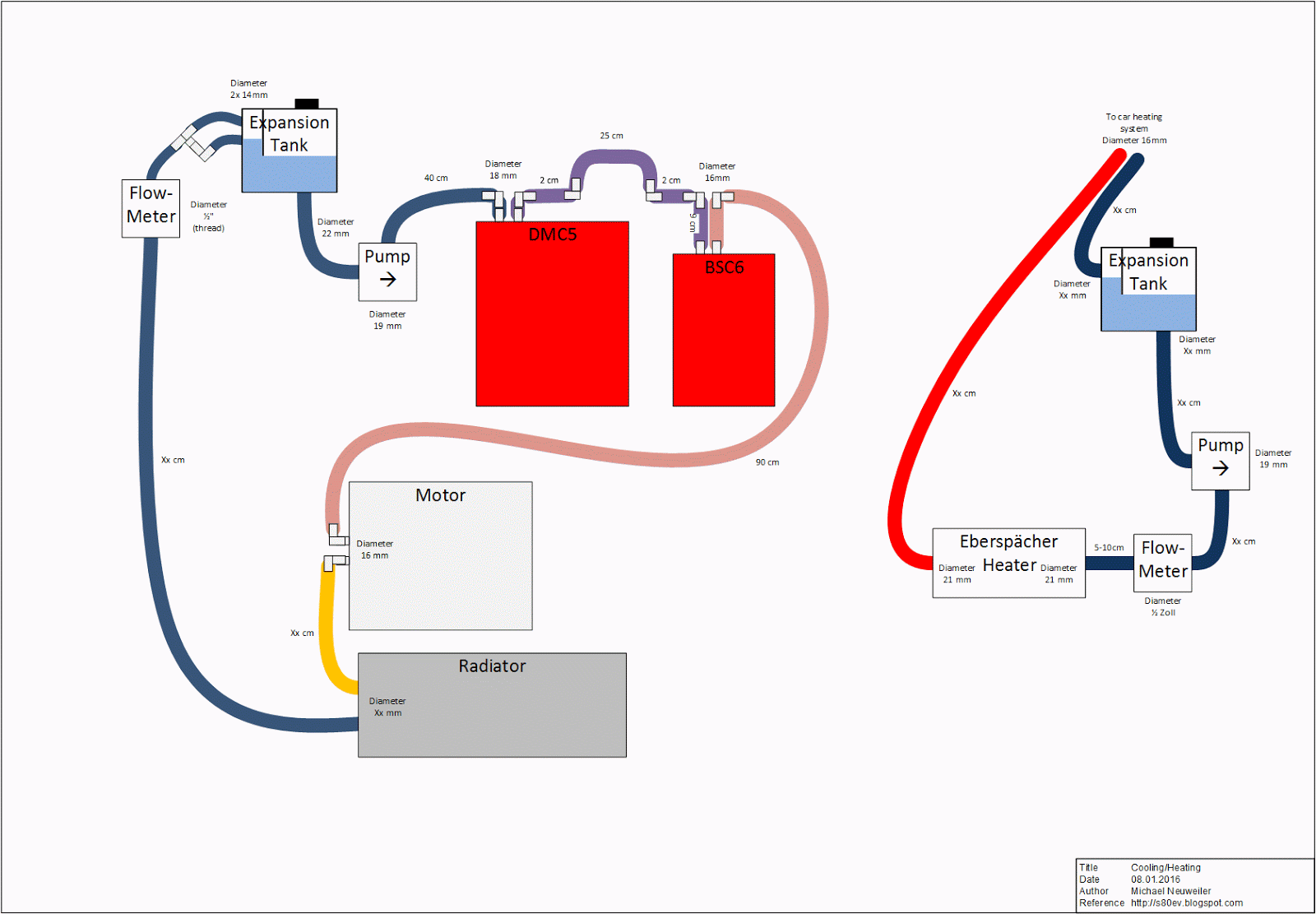
Another thing that had to be re-done was the cooling loop. Before I just forced the hoses and they got wrinkled reducing water flow. I used 90 degree angles to get the hoses straight and prevent damage. One important change to the system is the integration of the expansion tank. Before it was hooked up with one hose only so air bubble could travel up the hose and water flow down passively. This caused a lot of effort to vent all the hoses and I had to play with the Bosch water pump a lot - which doesn't like air at all. Now in the new setup I use the two small overflow return connectors to pump the water into the tank. Due to some walls, no air should get to the outlet on the bottom. The pump is attached right after the expansion tank so once it's filled with water, no more air should reach the pump and the system will rid itself from air automatically. The only thing missing here is the radiator - here I just can't make up my mind and at the beginning I'll just use the long hose to dissipate heat in the air flow. But this won't work in summer or when driving uphills.
I use water flow sensors to monitor the flow of the coolant and especially of the water passing the heater. If not enough water passes the heater, it will be disabled immediately to prevent expanding steam destroy anything. The maximum flow rate I get at the moment is 5 liters/min. For a pump rated at 15 liters/min it's a bit low suggesting some resistance in the loop. I hope it's because of air which might still be present in some hoses with a steep angle. When driving over a couple of bumps and curves, I expect the air to vanish because from the shaking little bubbles should find their way out.

ABS - finally some snow !

The day we had enough snow on the roads, I took the car out for a quick spin. I wanted to find out for a long time now if the anti-block-system works eventhough the ECU thinks the motor is not running (anymore). It's an absolute requirement to get the car street legal. So I was a bit anyious about it. Would I first have to fake engine signals to get the ECU running or would it work without? So I accelerated to 20kph and hit the brakes... and.. the familiar krrrrrchhchchch started - a clear sign that the ABS was working. Cool !!! :) Let's also test the anti-spin functionality by pushing down the throttle a bit harder and even here: the brake was automatically applied to the spinning wheel and the throttle was reduced. Very nice ! Well done Bosch and Volvo ! :) Me happy !

Summary - All good things come to an end

After installing some more cable protectors and the 6 temperature sensors in the battery bay/boxes, I'm re-adding the car body parts and it's really really coming to a point where I can think about getting the car street legal again. Some covers on the floor to protect the batteries from salt water, some construction foam to seal off the more complicated areas and to hold the batteries in place.. and we're good to go. Even if I'm required to have a working heater, I could get that up and running in a breeze: the code is ready, the heater installed, the pump is available... only a couple of hoses, a connector for the pump and an expansion tank are missing... compared to the rest: peanuts ! :)
It's funny, you might think "finally" - me too of course - but in the recent weeks, I was just in a mode "get into it and work late on the car during the week". It hit me once late at night that it's coming to an end while I was looking for things to work on. From rear to front, it was hard to make out anything. All cables are securely attached, everything is getting nice and tidy.. it's really surprising when you're in some kind of routine to realize it's about to change. :)


Tuesday, November 17, 2015

Battery Box Progress

Based on input from Walter Fassbind I contacted www.fahrzeugausbau.ch. Within a couple of weeks, they created a wonderful battery box made of black PE (poly ehtylene). The 1cm thick walls are perfect electric insulators and so strong, they hold up 9mm bullets. Once the walls are welded together, the connection is almost unbreakable. In a test with two pieces, the size of a hand, welded in a 90 degree angle, they drove over it with a car. The plates almost flatted out but didn't break and returned back to the original form almost immediately. In my opinion this is the best and safest material for battery boxes - although it doesn't stay 100% inherently stable when hot and is also inflammable, the stability is good enough and you'll have to use a bunsen burner for about 1 minute to get it burning. Plus, the box can be made 100% water proof! You can treat the material with the same tools as wood (fad, drill, knife, rasp, ...). The only down-side is that you can't glue any other material to it - but bolts for wood work very well. (sorry, it's a bit dirty on the pictures to the right)
In my original design I wanted to add two internal walls to support the floor of the second level. But after consideration, we decided to let the 2nd floor just rest on the bolts of the batteries on the 1st floor. This means one cell will rest its weight on top of another. That's not much load and shouldn't cause any problem - I hope. But it safes space which is critically low - especially in the vertical. The box with cover has to fit under the front end. And there it really is a matter of millimetres. I had to file off some edges to make the box fit under the front.
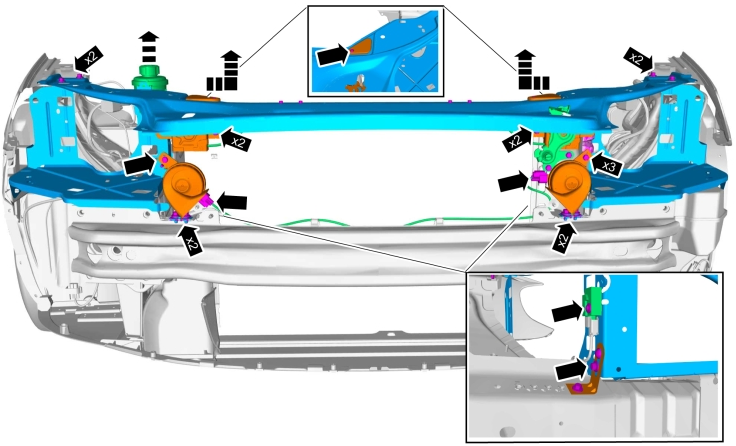
The box rests on a U-shaped aluminium bar (35mm x 80mm x 4mm, length 108cm) and is bolted down with 3 M8 countersunk bolts. The bar is mounted on the original mounting brackets of the radiator (cyan marked part in diagram). Another two countersunk M6 bolts attach the box to two latches of the bumper (just below the horns) for additional lateral stabilisation. Aside from the aluminium bar the box also rests on the thinner bar of the sub-frame (black arrows in second diagram). So the weight is distributed between the two bars.
The guy creating the box also came up with many other great ideas. E.g. we've added a lid to the upper rear side of the box to support the device board. This solved another big issue on how to mount the board in an engine compartment with almost no straight lines. Now I only have to add a couple of angles to the firewall and the entire board is sufficiently supported. The white board template is currently being converted to an aluminium board by www.fahrzeugausbau.ch. The Eberspächer heater will be mounted to the bottom side of the board, just above the motor.
So aside from a small battery box in the rear (spare tire compartment) the HV distribution is getting finalized and ready for use. With a cover for the mid-section batteries and the power-steering connected I can start to plan a test for street readiness. :) *joy*

Friday, November 6, 2015

Short Circuit

Ever heard these well intended hints :

  1. Wear eye protection when working with batteries!
  2. Wear gloves when working with batteries!
  3. Glasses with a metal frame dropped on battery terminals will turn into a ball of hot plasma flying in your direction.


How serious did you take these advices? Honestly? Well, I respected them partially. I've seen the spanner creating a short over the poles of one single cell (at 24:30). After 10-20 seconds it was glowing white from the heat. So I was really really careful when installing the batteries. Also when I took them out of their provisional enclosure last weekend. I held on every strap I loosened so it couldn't turn and create a short. I reminded myself at least 5 times during the first ten minutes: "Be careful! Concentrate!". And yet, I made a serious error: I removed one bolt from a strap completely and only then started loosening the second bolt. The strap slipped out of my hand and created a short with a cell in the next row - over about 15-20 cells in series. Oh my! I won't forget that crackling sound and the feeling. It' possible that I imagined it but it felt like I could feel the magnetic field. I believe it took me less than half a second to grab the strap again and break the short. The result can be seen on the pictures and the video. Fortunately just 2-3 minutes before, I put on gloves to protect my hands from physical injury (scratching those bolts can tear your skin). The copper on the straps melted immediately and sprayed around the trunk in little liquid drops. On one picture you can see them and their burn marks in the carpet of the trunk. Imagine these drops landing on the skin or worse into an eye. I was wearing only my glasses which cover only about 70% of the area. Also discovering drops of copper below the emergency vent caps of some cells and looking at the black trails on the battery casing, I consider myself extremely lucky not to have gotten injured.
Once the smoke cleared from the trunk and I was sure nothing would happen any more, I had to take a walk outside - with weak knees. Next to the car stands a wagon filled with hay - imagine sparks flying over. I also remembered mounting the cells under the car. It was all done over-head, no hat, no eye protection. Believe me, I'd never do it that way again! At least a chap and full eye protection are a must - like it is for over-head welding.


Wednesday, September 9, 2015

Battery Box Depression

Huh ? What's that supposed to mean? A depression because of battery boxes? Well.. yes and no. The reason why I didn't post for so long albeit I was celebrating a big breakthrough is the following:

As noted in my last entry, the work wasn't done yet. After the "high" from the first ride it was hard to get back and get dirty. It was more fun to take the car out for a quick spin. Then summer came, it got really hot and who wants to work in a garage with sweat dripping from your forehead at 40°C? You'd rather go to the public bath with the kids, right? Yeah.. well, all nice excuses which of course also played their part. The truth is, I got mentally blocked. I found a nice solution for the front battery box. But when placing the cardboard prototype in the engine bay, I found out there's a crumple zone which I never thought of. The beams carrying the front bumper do have some clearly visible notches which are intended to allow an easy compression and energy absorption in case of an accident. My box would fill out this entire zone with 150kg of batteries.
A friend recommended to check with the vehicle inspection first. They said that they see it as a critical topic, I should check with one of the certification agencies. They too said "It's critical" and sent me 60 pages of guidelines "Regelung Nr. 100 der Wirtschaftskommission der Vereinten Nationen für Europa (UNECE) — Einheitliche Bedingungen für die Genehmigung der Fahrzeuge hinsichtlich der besonderen Anforderungen an den Elektroantrieb", the so called ECE 100. On one page it says that either a crash test or a force equal to several tons has to be handled by the construction. Heck, how am I going to do that? I don't want to destroy my car nor any of the battery cells! I didn't get a official advice so I started thinking of alternatives. I'm not blaming any of the official agencies. Everybody was really supportive but as it's a special case probably nobody exaclty knows how to deal with such requests. All of my alternatives that came to my mind resulted in a complete re-design of the electric installation. A possibility would have been the placement of batteries behind and above the motor. But then I'd have had to move the HV-Box and all the Brusa devices to the front. A major redesign I wasn't looking forward to and which didn't promise much more success in the end.
I was sitting in the garage for hours - under and in front of the car without actually doing anything than brood and loose motivation minute by minute, not seeing any way to pass certification.
Then fortune sent me a favour: A friend gave me a nicely cut out article from a newspaper. It was about a guy in Lucerne who converted a '57 Chevy pick-up into an electric vehicle and even more: He created a professional system allowing him to use his car as source of electricity for his house, charge it with solar power and dynamically change the amount of electricity delivered from one system to the others - multidirectional. Probably the first system that works in real life and is not just some power point presentation. He's located a 30min drive from my home and also was so kind to receive me last week to explain everything he did. Result: 4 hours of techie nerd-talk :) The system he created based on Siemens technology is a real piece of art. In his garage he controls the whole system over a 17" touch screen - ease of use, statistics, full control- it's all included. But to me personally the biggest revelation was how he successfully passed inspection and got his Chevy street legal. It was a mental break-trough which made me decide to go ahead with my original design. But no, it's not 3 months lost, I also got very good advice where and how to obtain good quality battery boxes. He had his boxes created in a company located in Baar (15min drive). They're made out of welded plastic plates. The plastic and the connections are extremely robust, fire retardant and of course not conductive. Much better than any metal based construction. He told me that they made a L shaped test object and drove over it with a car. The object flattened out but did not break and restored its original shape once the force was gone. It's lighter than aluminium and can take many colours. Once I know more about it, I'll post more details.

I also bought myself a TWR JER 161 hydraulic pump used in Volvo V50. It should be possible to run it in uncotrolled mode but if you're able to send the right CAN messages, also make its power output speed dependant. It'll go into a compartment in front of the right front wheel - just like in a V50. Another device to be controlled by the GEVCU ? ;) More details can be found on DIY electric car forum.

So all in all: I'm back in business! :)

Monday, September 7, 2015

Maiden Voyage


On May, the 24th 2015 21:40 the worlds first Volvo S80 with full electric drive hit the streets. It was the maiden voyage for the car I was working on, in, above and under for the last 2 years. After a burst effort of 7days x 16hours of work, I was able to complete the tasks needed to get the car rolling. Many parts are still in a makeshift state (like the batteries in the trunk, control cables hanging loose, provisional mounting of devices, ...) but the drive unit is finished. Due to some misconfiguration on my part, the first couple of meters were accompanied with some surges and dead zones where the motor did not turn (as seen on the video where at the time I did not understand the problem). But once the car was moving, it was smooth like silk ! All you could hear is the gravel on the road and the soft hum of the coolant pump. It was perfect and the sense of delight accordingly high.
In the meantime I was able to correctly set all parameters and the car drives as reliable and smooth as a Swiss watch. Turn on ignition and one second later you're able to drive off. And keep in mind, aside from being the first electric S80 it's probably also the first converted car whose power output is controlled by interpreting CAN messages from the stock ECU. The GEVCU queries the ECU for the current throttle position and gets a response which was pre-validated by comparing the signals of two potentiometers on the throttle unit and possibly the throttle pedal too. The car's acceleration is also very satisfying. Taking off in 1st gear people (incl. myself) are astounded, in 2nd impressed and in 3rd satisfied with normal "sedan like" acceleration. No smoking wheels, but very close and much better than I expected. Actually the 70 cells in the trunk which are held together by a clamping set only, shifted 30cm from the back of the rear seat to the rear end of the trunk. I was unable to move these 250kg back by hand. All that's left to do now, is get the rest of the installation to production quality and street legal. Doesn't sound like much but two battery boxes are still missing, as is proper cooling, power steering and heating. Several weeks of effort - with some luck finished this year.

Note : Why the heck did I not put this onto my blog earlier ? It was in May and now it's September! I'll try to explain that in my next post.

Wednesday, April 22, 2015

Hard Earned Progress

Long time no update - sorry, I've been quite busy.

Bus Bars

As my design contained 4 bus bars with 5 connection points, I investigated alternatives to purchasing them - and spending about 400.-. Looking through the collection of left-over pieces in the metal shop, I quickly found a copper bar with a surface of 2.5 x 2.5 cm. The length was enough to be cut into 4 pieces. Costs: 40.- including 20 inox M8 screws and nuts. At www.swiss-composite.ch I bought 1L of resin they use to cover electronic parts for another 40.-. It stays flexible. Good in environments with vibrations but as I found out today, if you want to tighten the screws down, they start to slip within the hardened resin. Probably a hard one would have been better.
So, the costs were about a fifth of a retail product but the process was really fun and the "I'm proud" factor is quite significant. Check out the video how to do it.


HV Box

I'm also pretty proud of my HV distribution box. In the centre are of course the four bus bars and two contactors. On the upper/visible layer all HV connection points are made: from battery to contactors and then to motor controller and via fuses to JLD404, DC-DC converter, charger, heater. All 12V lines are immediately routed to the lower layer in order to separate the connections as good as possible (should one become loose). The main path is covered with copper bars. The low-power wires are short enough that they don't cause a short if one end comes loose. The end result is pretty heavy - about 7kg. With an aluminium L-profile on the top and bottom of the box, it was fairly easy to mount it in the car.

Motor Mount

This is definitely the area where the most effort was invested in and where the most time was lost. After spot welding all parts and then welding them down, everything got twisted and the bracket which hold the drive shaft in place no longer fit. Cut it of, weld again and then it was ok. But while the motor was resting on a block of wood on one side, I could not lift the car anymore and work almost came to a stand-still for several weeks. But now it's finished, painted black and fitting perfectly. I got some fantastic support from Peter and Reto at www.klaus-ag.ch - Thanks a lot !! Check out the video on the first spin of the wheels.


Battery Bay Construction

As I could not lift the car, finishing the battery bay under the car also had to wait. But now the final mounting brackets in the rear are in, the whole construction is rock solid.


Nordlock

When I wanted to order the Nordlock washers for the batteries, I was kindly invited for a visit to the branch in Switzerland. The sales representative wanted to do some tests with different types of washers in their lab. Although it would be beneficial to have a zink coated washer to serve as a sacrificial anode, it is not recommended. The washers don't show the nordlock effect but slip on the copper/aluminium. Also bigger washers than the screw's head is not recommendable. One might think it was because it distributes the forces more evenly. But also there the washers slipped on the copper strap instead of biting into the metal. With my CALB CA100 and copper straps, the best results were achieved with 25Nm torque and simple M8 inox washers. Refer to the video.

Battery Bottom Balancing

After having my batteries resting for 1 year with 50% SOC (from factory). most of them were in the same range with their voltage (see chart). The voltage of about 8 was considerably lower. So I suspected an internal soft short which slowly caused them to self-discharge. As I follow the philosophy of of bottom balancing and not using a battery management system (aka "battery murdering system") a internal soft short in some cells would become  problematic because they would fall out of balance and be under-discharged at some point - causing damage to them and become dangerous when charging them again.
After 5-8 cycles per cell I got them all discharged to 2.750 V (+/- 0.005V). With a Cellpro Powerlab 8 it took about 2 months. A most noteworthy effect is that the cells voltage climbs up for several weeks afer a discharge. Usually around 3-8mV per week. The 8 cells with a suspected soft-short drifted downwards after a discharge (whereas the others went up). They loose about 3-30mV per week after 4 weeks. As recommended by Jack Rickard, I charged them to 4V. My theory is that the so caused volumetric expansion might brake the dendrites which cause a soft-short. The cells were charged and now discharged to 2.75V. 7 of the 8 cells are still climbing in voltage which is a good sign. One is clearly gone. 3 days after the final discharge cycle, its voltage tumbles down. This one definitely won't go into the car. The others might in an easy accessible area (for monitoring and replacement).

Battery Installation

I installed the batteries in my construction. I the exhaust pipe tunnel, I had to use a hammer to widen it a bit in order to be able to install 2 more cells. Groups of 2 or 3 cells are interconnected with cable bridges. There were a lot of space related problems in area where the gas tank was. The distance from one row of cells to the next was too small. I counted for the bolts but not the thick cable shoes and cables. As I was out of options and didn't want to give up, I had to flatten the cable-shoes. I used a parallel vise to squeeze them so they become more flat. In the process I destroyed one vise. Also about 40 of the bolt heads had to be grinded down to half of their thickness. All this caused a lot of unexpected delays. In some areas the top of the batteries/bolts/shoes/cables are in contact with the bottom of the next row of batteries. No problem regarding HV security but accessing the terminals to verify the voltage has become impossible. The batteries are fixed very well laterally. But they might jump up when driving over a bump. To prevent that, once I'm happy with the installation, I will cover the batteries with plastic and then fill the gap with expandable construction foam. Also the bottom of the construction has to be covered with plastic plates to protect the batteries from salt water and stones. I'll also have to re-route the drain of the AC system - otherwise it would drip happily on my batteries.
I was able to fit 53 cells under car. For now I will put the remaining cells into trunk - only for a couple of test drives. Then they'll have to go into a battery box in the engine compartment.


Controller Shelf

In order to envision how to mount the motor controller, dc-dc converter, charger and GEVCU, I created a prototype board out of wood. One I'm happy, it will be replaces with an aluminium plate. If somehow possible, I'll attach hinges in order to be able to lift/tilt the entire construction and reach the motor and the HV box. It's a real challenge though, as in these modern cars, there are not 90 degree angles, no straigth lines.. everything is curved.


Temperature and I/O extension for GEVCU

The GEVCU offers 8 digital outputs. Although they use MOSFET's to drive them, it's not recommended to use them to drive a Kilovac/Gigavac contactor directly - because of the high inrush current. Because of that and because I'll need more than 8 output channels, I bought myself a 16-channel relay board for Arduino Due's. They're almost free on ebay (18-36.-). This board with it's own Arduino Due will talk to the GEVCU and listen to commands via CAN bus to switch the various relays. I'll also use 4-6 single-wire temperature sensors. They will measure the temperature of the batteries in various areas. The extension box reports the temperatures via CAN bus to the GEVCU, which in order will control the charge process and not charge below 5 deg C but heat the batteries first with a water heater.


Eberspächer 6kW Water Heater

I obtained a used Eberspächer coolant water heater from a Chevy Volt with the help of Jack. It's a powerfull little box that heats with up to 6kW. It uses PTC elements where the water flows around. It's controlled via a single wire CAN. Mark Weisheimer got it running already with a play-back of recorded CAN messages from a Volt. He and others are trying to reverse-engineer the CAN messages.